

I didn’t start 2025 with tremendous confidence. In January I would’ve told you that there was a 50 percent chance I’d return to product management after the year was over. It took several months before I got comfortable introducing myself as a “writer,” and several months more before I took the j-word in stride. It felt safer to act like I was in-between things, like I’d wrapped up my four years working at Substack and was now flirting with journalism as a low-commitment creative sabbatical.
Of course, I harbored a not-so-secret hope that the writing thing would work out. But I wanted to be realistic, so I wrote down three exit criteria:
Am I having fun?
Am I doing work I’m proud of?
Do I see a path to financial sustainability?
Three yeses would provide permission to extend the project for another year. Nos would send me back to a real job—no shame about it.
With this rubric in mind, I set off for the year. I wanted to go as broad as possible in my self-education as an independent writer. I did my first few reported pieces, including a WSJ article on home-cooked apps, one on Chinese spy mania, and a defense-tech piece that ended up being the SF Standard’s #1 most read all year. I kept Substacking and earned a Bestseller badge, over 10,000 free subscriptions, and north of 50,000 views on my most popular posts on Chinese tech and SF’s gold rush vibes.1 I worked with Kevin Roose to report a history book on the AGI race, interviewing nearly every luminary in modern AI. I made my debuts on Odd Lots and NPR, and was quoted in the New Yorker, NYT, and Financial Times. I also got my first hit piece, arguably two.2 I cohosted a bunch of parties, a magazine launch, a sold-out public debate. I recorded ten podcasts. I made lots of friends.
There’s a kind of solace that comes with hard numbers and credentials. You can show them to family members and social media strangers and even myself when I’m feeling especially impostery. They’re a reassuring proxy that says your work matters because other people told you so.3 Metrics are also, however, infinitely optimizable—I can’t look at that list without ruminating on all the subscribers and bylines I don’t yet have.
What’s much simpler is a three-question test of yeses and nos:
I had fun.
I did work I’m proud of.
I didn’t go broke.
What is it like to be a writer? I don’t know, what is it like to be a bat?
My hours and routine are quite basic: I write on a 16” Macbook Pro, I do not use a mouse or a monitor, sometimes I sit in a coffeeshop and other times at the big bay window in my San Francisco apartment. I work from 9am to either 5pm or 1am depending on the day. I do most meetings in the morning, and exercise in the evening or have dinner with friends. I travel more than I used to, cook less than I ought. My best reading happens on planes.
But all this is boring, I know. The writing life is in fact as transformative as they say, but most of this change happens invisibly, inside your head and heart.
When you become a writer, here is one of the first things you will discover: with about a month of dedicated effort, you can go from knowing nothing about a topic to being able to present fluently and converse with experts. The beginning will be painful. You will sound stupid for your first ten conversations, maybe fifty. At first jargon will look like gibberish, then it will be faintly recognizable, and then one day intelligible, like fog clearing from the hills; with every additional source you read, your story will reveal itself in greater fidelity and scope. “If you do everything, you’ll win,” as Robert Caro says. There is a comforting if-then determinism to Caro’s advice: research persistence is rewarded, success is guaranteed. You chip away at your hypothesis until something more interesting is revealed: an essay is a failure if you go in with an outline and it emerges the same shape. The world is both unimaginably intricate and more knowable than it looks.
When reporting, you will talk to people with vastly different beliefs than you, on topics you know well and those you don’t. You will be surprised by who you end up liking, then realize that “liking” has little to do with veracity or substantive agreement. The best interviews feel vaguely spiritual. Occasionally, you fall a little bit in love.4 But it’s only natural. How rare it is to listen to a stranger for an hour, asking them questions with the goal of forming a complete picture of who they are and what they believe, while prohibiting yourself from throwing your own takes into the mix. The coveted gift of unbroken attention—no wonder sources say too much! But it’s not all one-sided manipulation, as Janet Malcolm suggests. Journalistic integrity comes from checks and balances, your competing obligations to the reader, the source, the profession, and yourself.
The writer’s lens follows you away from the desk. Nothing is too small to put under the microscope: put on your anthropologist hat and you’ll instantly see in 4k. Travel becomes more vivid; you chat up strangers more.5 You move your Notes app to the home screen spot just under your thumb; this way, it’s faster to jot down everything you see: construction patterns, fashion trends, every party conversation you eavesdrop on. In Shanghai you notice that street stands have shuttered, customer service has improved, and still Chinese people hate taking the stairs. Everything is always changing, always interesting. Reread Annie Dillard: “Admire the world for never ending on you—as you would admire an opponent, without taking your eyes from him, or walking away.”
The point of longform writing is to say something not reducible to a tweet. “The tl;dr of a Sontag essay could only be every word of it,” wrote A.O. Scott. Or from Robin Sloan, in contrast to LLMs: “A good novel or poem is self-describing.” It must be possible to write about technology with a rationalist’s precision and a critic’s glamour. You read more magazine journalism, more LessWrong posts. You keep printouts of favorite essays in your laptop bag; when you bore of your own prose, you study others for tricks to borrow. But the ultimate goal is “voice,” that elusive essence from within, the sound of a pellucid inner monologue unencumbered by social mores. You’re delighted when people say you sound the same in person as on the page.
At some point in every writing project, it stops living in the Google Doc and starts living in your mind. Everything else you see and hear gets filtered through the frame of the essay. New sentences appear spontaneously, like apparitions, then rearrange themselves on showers and walks and when falling asleep at night. You get used to tapping out edits on your phone; three times, you’re so absorbed you miss your bus stop. In the throes of deep revision, it’s best not to talk to friends—it’s when you’re at your most insufferable and single-minded, unable to talk or think about anything else. Publishing, finally, feels like a long exhale.
Post-publish, your email inbox will become a weird and wonderful place. You will get letters from people who moved to San Francisco in the 1970s and in 2024, stories about Shenzhen’s toddler years, when “skyscrapers were shooting up like mushrooms,” and more invitations from editors than you can accept (a champagne problem, of course). Press tickets to the theater and ballet, advance copies of books. Receiving these emails makes you feel like the richest person in the world: What had I done to deserve so much knowledge? Blogging is not only a search query but a kind of prompt for human wisdom: the world will respond with the seriousness that you put into it.
You make a list of your favorite living writers and intellectuals. By the end of the year, you’ll have met half. They will offer advice, encouragement, introductions, an ear—or even more miraculously, treat you as a peer. You squint to see what they see in you. Maybe they’re just being nice because writing is already so solitary and precarious, and independent writing even more so. By November, they have successfully beat the self-doubt out of you, all the while encouraging you to grind harder still. On one hand, you technically work alone; on the other, you have more collaborators than ever before. Everyone deserves to be bet on, you think.
You know you can’t force success. You can’t predict what will hit. All you can do is cultivate the conditions for good writing to emerge. Better inputs, like essays, books, conversations, and travel; a makers’ schedule designed to maximize uninterrupted four-hour blocks; the personal focus and discipline to use them well.6 But some degree of unpredictability seems inherent to the work. To paraphrase PJ Vogt, creative livelihoods depend on this ineffable ability to make work that resonates with people, to keep summoning new forms of this magical je ne sais quoi. No matter how many achievements you notch, you’ll wake up every day and still wonder: Do I still have the juice?
To live or die based on the unpredictable, inscrutable machinations of your own mind—it makes the highs higher, and the lows more damning—that is what makes creative work terrifying and exhilarating like nothing else.
“The aim of all commentary on art now should be to make works of art—and, by analogy, our own experience—more, rather than less, real to us,” wrote Susan Sontag, my icon. The critic’s first duty is to explain, not evaluate. Too much writing on tech still rushes to gawk or condemn. It’s why I’ve focused this year on training my journalistic and ethnographic eye instead: I wanted to remake my ability to see.
The goal of my work is to help people understand Silicon Valley better—where “people” includes Silicon Valley itself. Its culture, its political economy. Why tech leaders believe what they do, even when it seems irrational or insane to the public. What people mean by “AGI,” “Chinese peptides,” and the “permanent underclass.” The relationship between startup marketing incentives and the vice-signaling epidemic, between the AI boom and the academic community. The culture of DIY healthcare and radical self-experimentation. The addition of China envy on top of China fear. How people who seem so charmless and inexperienced managed to rise to the highest echelons of the US government (the answer is more nuanced than “money,” though that’s one part). Why legions of passionate, brilliant kids from around the world keep flocking to SF. (Those zoomers are becoming data billionaires and yassifying the Epstein files and hosting ethics debates in Catholic churches.) The memes and semantics and subcultures that constitute, as I called it in January, the “happeningest place in the world.”
I don’t have a big launch or pivot to announce for 2026, but what I’ll instead promise is the dedication that comes with confidence in this vision. Understanding the tech industry—especially at a time when the whole US economy rides on its promises—is more essential than ever. Yet there are so few people reporting from within this crazy milieu, and even fewer doing so for a general audience. Strategically, I mostly need to be doing what I’m doing but more.
While I spent about 40% of my time last year writing on Substack—the rest split between researching the AI book, podcasting, contract projects, and freelance reporting—I plan to double the Substacking to 80% next year, with the rest being high-impact freelance features. It means giving up the contracts that were my main income sources, which is certainly scary. But I think it’ll result in better work in the long run: I’ll get to bring more reporting to this newsletter, where I can write faster and weirder and about nicher things, and focus fully on work under my name and direction. This year has given me more faith than ever in the Substack model: that creative independence and a direct relationship to readers is the only way to go.7
I spent most of 2025 covering AI and the LLM race, but really enjoyed my brief forays into defense, biotech, and manufacturing—and hope to investigate those topics more deeply next year. (There will still be plenty of AI, of course.) I’ll return to China again but hope to visit other new countries too. I’m still not sure how much politics writing to do.
I had an unexpected amount of fun doing SF events like the Substack debate and writer happy hours, and am keen to do more if I can find the right partners and sponsors. My sense is we may have hit peak podcast, but longform writing and great parties are forever lindy and scarce.
When I left my startup job, the breaking point was feeling like I could no longer think my own thoughts. My brain had melted into a jumble of dashboards and Linear tickets and Slack notifications. I was peripherally aware of other things happening in the world—Ukraine! Crypto crash! ChatGPT!—but had no bandwidth to look at more than the headlines, never mind form my own beliefs. I often sat down in front of a blank page and literally thought my creativity had died.8
So I became a writer to live more of the life I wanted to live. It was a relief to find the thinking muscle still pulsating underneath all that cruft, and an even greater joy to discover that there is a real, serious readership for the work I want to do. Today I feel more like myself than ever. Something about this feels natural—even predestined. I joke that writing is my “post-AGI job,” the thing I’d do even if money were no object. Finding the thing that doesn’t feel like work: this is what real wealth is.


misc links & more
A highlight of the month was hosting a 500-person debate on Utopia in a historic SF nightclub. Lots of laughter and champagne, and even write-ups in two local newspapers. The full recordings are up on Substack’s Youtube now.
I felt a bit bad for making this post all personal writing meta instead of smart thoughts about AI in 2025. To make it up I’ll recommend a few other AI year-in-reviews I enjoyed, each with their own perspective (and delightful prose to boot):
Zhengdong Wang: What does it mean to “feel the AGI,” or “internalize the scaling laws”? I’ve had this conversation over and over this year, and Zhengdong’s letter is by far the best articulation I’ve seen. Reading this also just imbues me with a real sense of awe—what a wild ride we’re on, and how lucky we are to witness it!
Samuel Albanie: More compute theory of everything, but also great thoughts on evals encased in British wit: “We are building systems that show early signs of generality, but our evaluation tools must be parochially specific. We are building a universal Swiss Army knife, but we can only test it by asking, “Yes, but can it open this bottle of lukewarm Pinot Grigio?””
Jessica Dai: What is it like to be a researcher? Jessica starts her recap off with a rebuke of the AI “circus”—all the hype and the discourse and academic LARP—but closes it with a dead-earnest ode to doing “real work,” that is, research with intent, that aims to do something in the world.
Gavin Leech: This is the most comprehensive and sober review of technical AI progress I’ve seen. Well-cited and readable.
One final belated Christmas gift: my 2026 ins & outs. I swear I had “art patronage” on here for weeks before the Tyler/Patrick “New Aesthetics” grant. And as always, predictions are NOT endorsements.
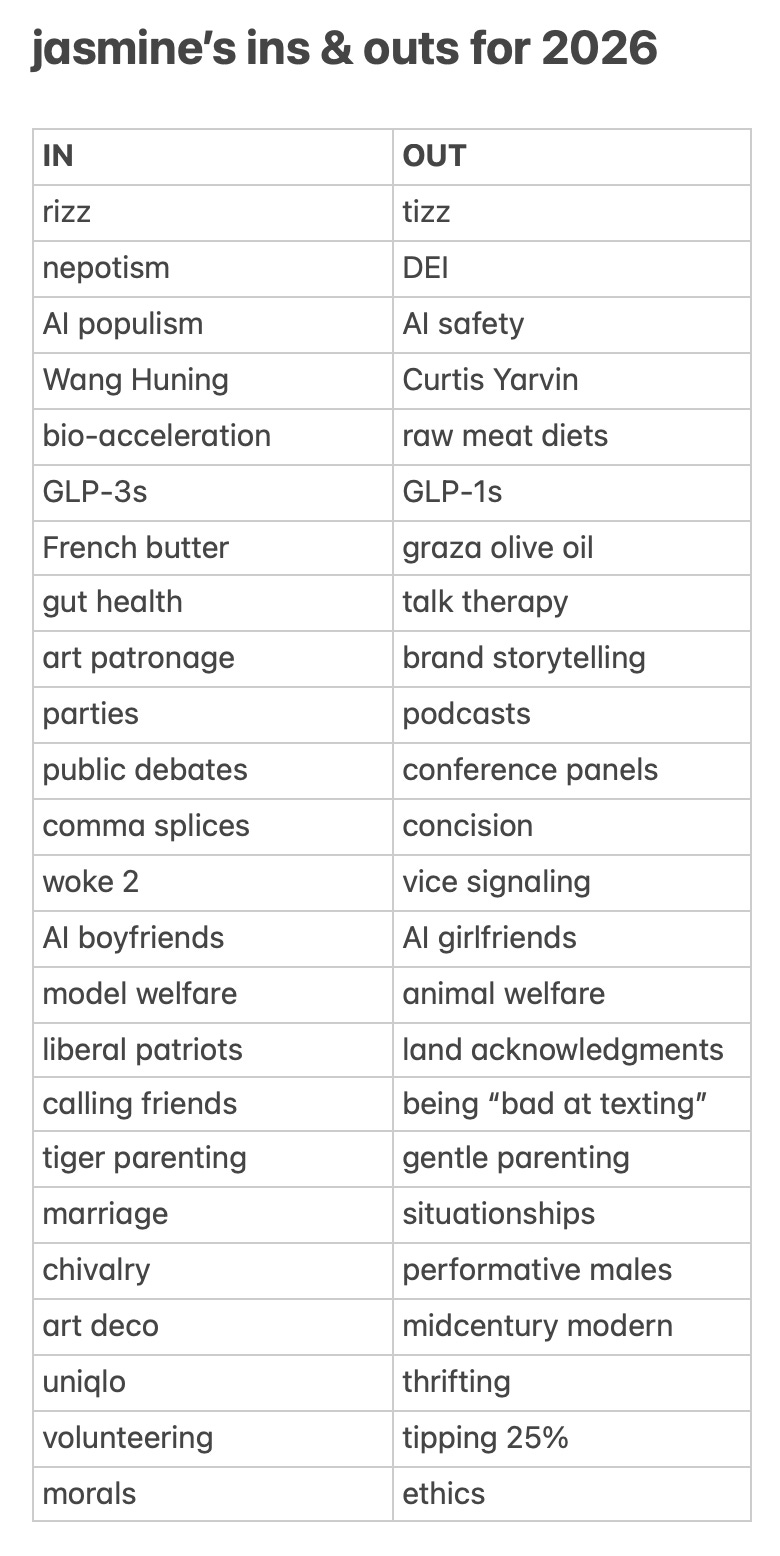
Happy new year!
Jasmine
My numbers are peanuts to many, and short of where I want to be, but still meaningful. And I was shocked to learn from a senior WaPo reporter that they consider anything over 10,000 views good!
A writer for a local left publication made me the focus of a limp, error-riddled feature on tech’s “new right-wing intelligentsia.” I was amused at what crimes earned me this label: not booting a right-wing writer from a happy hour, and Kernel receiving an Omidyar Network (b*llionaire philanthropy) grant. You’d think they’d have better targets to shoot at.
And despite being totally uncorrelated from actual media consumption habits, print still grants legitimacy to early-career writers. Blogging just makes you look unemployed.
Not that kind, but something closer to deep knowing and empathy. Oddly I don’t experience the same connection from podcast interviews—it’s hard to shake the performance aspect.
I like picking one question to ask a ton of different people about, like an informal survey. This helps capture a range of opinions and also makes it easier to start conversations in the first place. E.g. in Taiwan, “Why are people so civically engaged?” or in China, “Do you feel that your life is very juan?”
I keep thinking of the IABED line that “Models are grown, not crafted.” Or to extend the metaphor way too far, reading/interviews = data, writing craft = algorithms, and time = compute. Once you have strong conditions in place, you have to trust the process to work: I think writing really does remind me how much of a black box my own brain is.
Working with editors has helped me become a more rigorous reporter, fact-checker, and understand what’s common knowledge vs. not; and there’s a higher ceiling for how far an article can go. But most things I’ve written here are unpitchable to mainstream outlets. I’m too loose with anonymity, there’s no sharp scoop or take, there’s too much inside baseball I’d have to explain. I also like that Substack allows me to “sound like myself.”
I don’t think all jobs necessitate this; I’m just a very monomaniacal person. Celine Nguyen, in her latest, offers why you don’t need to quit your day job to write. (I do agree that if you aren’t writing at all with a job, you probably won’t magically find the motivation without one. For me, I spent 2024 trying to get more serious about writing “on the side” of my job, and doing some, but eventually realized it was untenable to do both at the level of seriousness I thought each deserved.)
"To live or die based on the unpredictable, inscrutable machinations of your own mind—it makes the highs higher, and the lows more damning—that is what makes creative work terrifying and exhilarating like nothing else."
This is the way. Congrats on making the leap in 2025. Cheers to 2026!
Jasmine, this was so wonderful to read—an accelerated tour of all your GREATEST HITS in 2025, plus your experiences with the labor of writing…the interviewing, the patient arranging and rearranging of ideas in a Google Doc.
I love your writing and instantly read whatever shows up in my inbox. You have a really rare mix of internet-fluent humor and quotable zingers, without sacrificing the subjective depth that even the most ridiculous SV/tech trends reveal about society. I feel extremely lucky we are friends; I’m constantly invigorated by the work you do and how clearly you think!!! Have a wonderful 2026.