

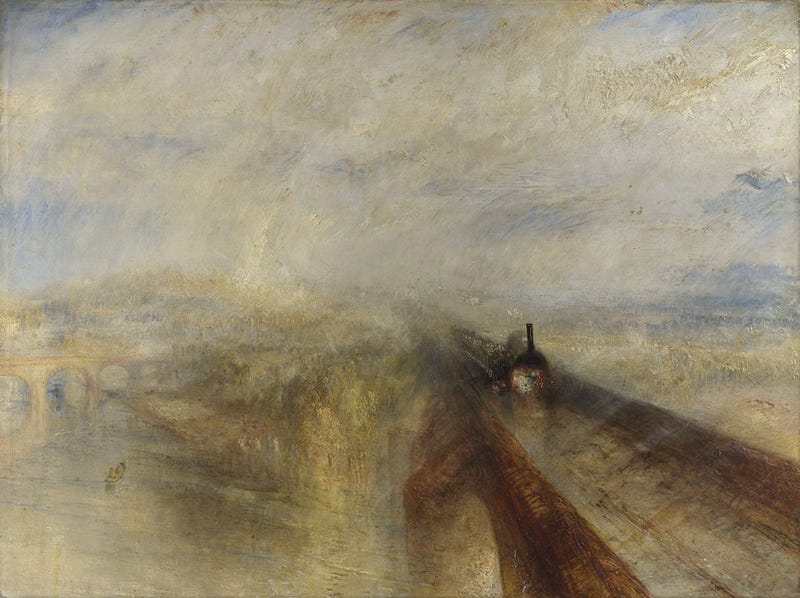
It’s a scary time to be twenty-two. Recently, I’ve been watching videos of college commencement speakers getting pummeled by boos for talking about AI. I’ve seen the charts showing post-graduate employment rates for engineering majors falling by 5 to 15 percent. And it’s not as if young people were having an easy time getting good jobs, buying homes, and starting families before AI. They say that every technological revolution screws over the transitional generation. Today, it’s all transition, all the time.
A little over five years ago, I also graduated into a global crisis. In 2021, Covid kept us quarantined in four-to-ten person pods, Zoom calls still dominated socialization, and long vaccine waitlists rationed real-world mobility. Tech companies were beginning to recover from 2020’s hiring freezes (though new grad hiring would take another nosedive in late 2022); everywhere, newsrooms continued to shrink. After taking a leave of absence from Stanford and extending it three quarters in a row, I finally internalized the fact that I was never going to return. I broke up with my college boyfriend, moved first back home, and then into two co-ops full of strangers. I found and started work with no diploma. Once vaccinated, I signed a lease in New York for no reason except that I could. Forward was the only way.
Those Covid years were the most transformative of my life. It was creative destruction. Most people’s experiences were not rosy—yes, I recall the death, trauma, isolation, and chaos—which is why I don’t like to talk about how good it was, for me. But it was. The pandemic acted as a permission structure to make unconventional decisions, to escape campus pressure and sort out what I really wanted to do. My first career, at Substack, was made in Covid’s wake. My second, in journalism, is being made by AI.
That has taught me some lessons: in times of change, your disposition is as important as the hard skills that you build. So this is my attempt to share guidance for young people making a career—and a life—in the age of AI.
First, no nostalgia! The old world was bad. Those staid institutions and rigid hierarchies are not worth mourning. I went to a grinder high school and a grifter college. Both were mostly shitty and anti-human ways to live. Nothing makes you feel as compressed, quantized, and box-checked as AP season or the college application process. The notion that teens can smoke weed and skim Hegel for four years and have a cushy office job waiting on the other side was always doomed. Did new grad engineers have a God-given right to a $200k starting salary, while schoolteachers and paramedics grind for a fraction of the wage? There have to be better credentialing systems than one’s willingness to go into debt.
So don’t shed a tear for the strivers. Think of the rules, norms, and strictures that you feel most suffocated by. Enumerate every if only in your life, all the things you’d do if you were brave enough, if nobody was judging. What would you do if you were barred from the rat race? Now is your chance!
The thing about crisis is that it makes the world topsy-turvy. Consider the following provocations:
Freelancing is as secure as employment
Founding a startup is as secure as a big tech job
Young people know as much as seasoned professionals
Physical labor is valuable; cognitive work is cheap
Nothing is sacred; everything is fallible
Some insist that touching AI will leave your soul forever stained, while others insist that tokenmaxxing is the only way out of the permanent underclass. I think both are wrong, and we should learn from the economists. What is your comparative advantage as a human? What traits will be scarce? How can you stay a complement to machine intelligence? These are the qualities to lean into most.
charisma, people skills, personality hires
AI makes the world more nepo. So go make some friends. Let’s say there is a “human premium” where there are some services where people would prefer humans over machines doing them, even if the people are technically inferior. Well, this only works if the human is a really good hang. Become the good hang. Sometimes people assume that social skills aren’t practicable, but they are. You can choose to be funnier, kinder, and more empathetic. Pay attention to the people you like best, and study the traits that make them glow.
Become more visible, because this makes it easier to make friends. I detest the term “personal brand,” because a brand is artificial and strategically constructed. Instead, be yourself, but more loudly than you were. Pick one online platform to be active on—that’s the easiest way to stand out in a crowd. Or if you hate the internet, join a club or organization that makes meeting new people easy to do.
Participate. Go to parties, host parties, ask people to coffee, ask people on dates. Pick an activity you already wanted to do and announce “I’m planning to do X, if anyone wants to join me” online and at events and to every friend you encounter. I’ve done this for book clubs and zine-making and international trips. The key is to sound like you’re going no matter what. People like to join people who already have a plan.
Isn’t this supposed to be career advice? I promise it is. Relationships are how you’ll escape the hellfire of a thousand-person LinkedIn resume stack. Relationships are how you earn the trust to make the sale, because even the biggest rationality bros are vibes-based decision-makers. And relationships are how you’ll stay sane when you get rejected / laid off / burned out anyway, because none of us are immune to having shit luck.
discovery, grass-touching, tacit knowledge
Play in terrains where there is no training data. A surprising amount of the world’s information has never been written down. Be courageous. Go outside. Don’t just monitor the situation from your phone and your toilet seat: Get like Analyst #3 and turn up to the Strait of Hormuz. The more out-of-distribution your adventures, the bigger moat you have. And if you’re one of the only people to know something, you can sell that info too.
AIs are not very “sample-efficient.” They need reams of data to learn simple concepts and skills, whereas humans can pick them up after just a few tries. That’s why LLMs have to ingest the entire internet to learn that Paris is in France and also in Texas, and why robots need to watch thousands of t-shirt-folding videos to stumble through it themselves. When I worked at Substack, I was usually the first person with each of my job titles. I’d sketch the basics of a role, let someone else refine it, then do something else. A friend suggested that all work might be like this in the future: a human does the task a few times, then teaches it to the AI. No matter how uncomfortable you find your first attempt at something, you’ll probably improve faster than a robot will.
Or pick a domain where tacit knowledge reigns: intuitive, embodied skills only learned through the act of doing. Turn on your five senses. Get reacquainted with your hands. Can you feel when a dough is hydrated? Can you close a wound with a steady stitch? When TSMC opened their first factory in Phoenix, they learned that all the blueprints in the world couldn’t teach an American the years of tacit know-how developed back home—the company had to bring over Taiwanese talent to train the US staff.
You won’t imbibe tacit knowledge in a classroom’s confines, so find a mentor to take you under their wing. Textbooks are out; apprenticeships are in. Absorb everything that experts know.
humility, flexibility, the moat of low status
When I hear elite college grads talk about not getting jobs, I wonder whether they can’t find anything or if they’re simply too narrow in their aims.
Firms are getting smaller. You cannot all work at Google. The layoffs are starting and they’re not going to stop. (Sure, most weren’t caused by AI, but agents may be the reason they don’t backfill roles.) Get good at leveraging AI in the real world—go home and find a mom-and-pop shop to make more efficient. Put agentic workflows in places they don’t belong. Start a business selling complements to AI: host conferences, deploy robots, collect esoteric datasets. Don’t bet on companies that only do desk work. Run the most efficient human services business in the world.
Prestige is a brain worm, and its shape changes all the time. Keep your identity small, and don’t fear starting over. The people who will win are those who can remake themselves again and again: to summit one peak, descend it, and then hike up the next. Know your fallback plans. If I wasn’t a writer, I’d go back to product, and if I couldn’t do that, I’d work in policy or comms. I also like to teach, host events, and lead group travel. I’d be a slow line cook, but could do that too. You must imagine yourself happy in any number of worlds. There is nothing “higher status” than excelling joyfully at what you do.
Avoid long-term commitments (or be okay with tossing them).1 But don’t be half-hearted; go all in while you can. Jump at opportunities. Work really hard. Sprint—then recover, because you don’t know when the next race will start. I worry more about my friends who are used to delayed-payoff strategies than I do about the dilettantes who hop from one gig to the next. There is no such thing as a fifty-year career anymore. At maximum, plan for five.
self-awareness, discipline, a working BS detector
I am admittedly worried about AI making people stupid. AI makes it too easy to lie to yourself: to self-congratulate for the illusion of learning, thinking, and productivity. It turns hare-brained notes into grammatical sentences, doing the cleanup for you (and the mental processing too). It takes meeting minutes and you assume it’s like listening; it’s not until later that you realize you don’t recall a thing. You’ve got to actually know: Am I being more productive, or just tokenmaxxing? Am I upskilling myself with AI, or letting it do the hard part for me? Does my essay/business/product idea make sense, or did I let an LLM convince me it does?
Humans will not win by trying to outrun the AIs. They are more powerful slop cannons than you are. The students who ChatGPT their p-sets are only shooting themselves in the foot: Why would anyone hire a 22-year-old with Claude Code when they could just use Claude Code? The AI tools are undifferentiated and everyone has them. Your comparative advantage has to be about you.
I have no solution except that real work has a feeling. I know the difference between reading a book and its summary, like athletes know when they’re pushing themselves in training versus phoning it in. The reason to write your own essays isn’t that Claude can’t do it better—it’s that writing is thinking and you shouldn’t wither away your brain. Use AI to get smarter and don’t let it make you dumb. There’s a cognitive equivalent to lifting heavy. Do it three or four times a week.
wall-busting, gumption, stubborn self-optimism
The world is unfair six hundred ways to Sunday—yet you just have to believe that your fate is in your hands.
In seventh grade, I had a notorious math teacher with flaming red hair and a thick Russian accent, who eschewed newfangled Smartboards for ancient overhead projectors, and swapped standardized textbooks for The Art of Problem Solving. Her favorite lesson plan was throwing up a nasty proof and letting each cluster of desks spend a whole class figuring it out. If we asked for answers, she’d simply tell us to strahhggle, shaking her head and punting us back.
One of my old managers at Substack took a similar tack. I’d bring a problem to our one-on-ones—a failed growth experiment, some intra-team spat—and he’d ponder for a second, before saying “That sounds solvable.” Then he’d change the subject, leaving me confused and alone. Both strategies were infuriating at first, but surprisingly effective. If I gave a problem thirty minutes of dedicated thinking, eventually a solution would inevitably appear.
The point of such persistence is building problem-solving reps. Look for side doors! Actually Try! Phone a friend before giving up! Note every time you accomplish something that looked impossible at first. Insist that you can beat the odds.
AI agents are bad at dealing with unforeseen obstacles. Waymos and Roombas still get stuck. Your job is to be more resilient and adaptive than they are. Many roles will involve babysitting agents: knowing when to call their bluff, when to intervene, and acting as the connective tissue between digital systems. Practice executing logistically complex plans. Remember that jobs are not defined by a skillset, but the ability to unblock outcomes, whatever it takes. Do not specialize in SOPs.
life, liberty, the pursuit of happiness
Lastly: take breaks. Become more of a hedonist. Learn to love leisure and really have fun. If there is an underclass, 996 won’t save you. “Get hobbies that don’t involve computers,” as Jack Clark says. Among my friends: figure skating, croissant-making, Cantonese interpretation. Bum a cigarette off a stranger between once and thrice a year. Party. Fail some marshmallow tests. Just don’t die before AGI.
I don’t normally like to dispense self-help. Advice is context-dependent, and often looks like survivorship bias or bootstraps moralizing. Caveat: privilege check: I know that I’m lucky; there’s a reason I usually talk about systems instead. But now some are too down on the whole agency enterprise—they assume all abilities are baked in from birth. I often ask AI folks what they’d tell a normal 22-year-old. Don’t know, they’re screwed, is the non-answer I get most. In that response, I hear depressing defeatism: What can anyone do in the shadow of the technocapital machine?
Faced with such fatalism, self-help seems essential. Disruption is real and it’s hard and we’ve made it through before. You can do more than you think you can; you are more malleable than you think you are. You don’t choose the game board but you choose how to play it. Relish the pivots; ride the waves; recite the Serenity Prayer every morning and chase sunsets at night. I won’t tell you that the future’s smooth sailing. But what a thrill to be alive!
links & life updates
There are practical things I can recommend new grads: Find work related to AI (e.g. join a lab, build data centers, work on AI policy); these roles will grow in demand and be genuinely impactful. To layoff-proof yourself, pick healthcare, the public sector, or any unionized trade. If you want to be a great hire, play with agents a lot and become their master. Feel the jagged edges; learn where they work and where they fail. But you can find that all on LinkedIn. I wanted to focus on the attitudinal stuff, which was more important to my personal growth. And if all advice is contingent anyway, I’d rather be provocative than say nothing at all.
I’m interested in writing about AI-native teenagers (roughly 12-15 years old). Just like I was part of the “internet generation,” which shaped my early educational and social life, I want to know: What is the “AI generation” like? I’m sure the answer is more complex than just cheating and suicides. If you have a teen who is an AI super-user, I’d love to hear about it—send me a DM or email at jaswsunny at gmail dot com!
I’m part of the first issue of the new art/tech magazine Culture Slop, where I interviewed the always-wonderful Fred Turner about whether Silicon Valley still has a counterculture (here’s our previous interview if you haven’t seen it). Subscribers can get a free issue at this special link (code
SUNXSLOP, just pay for shipping).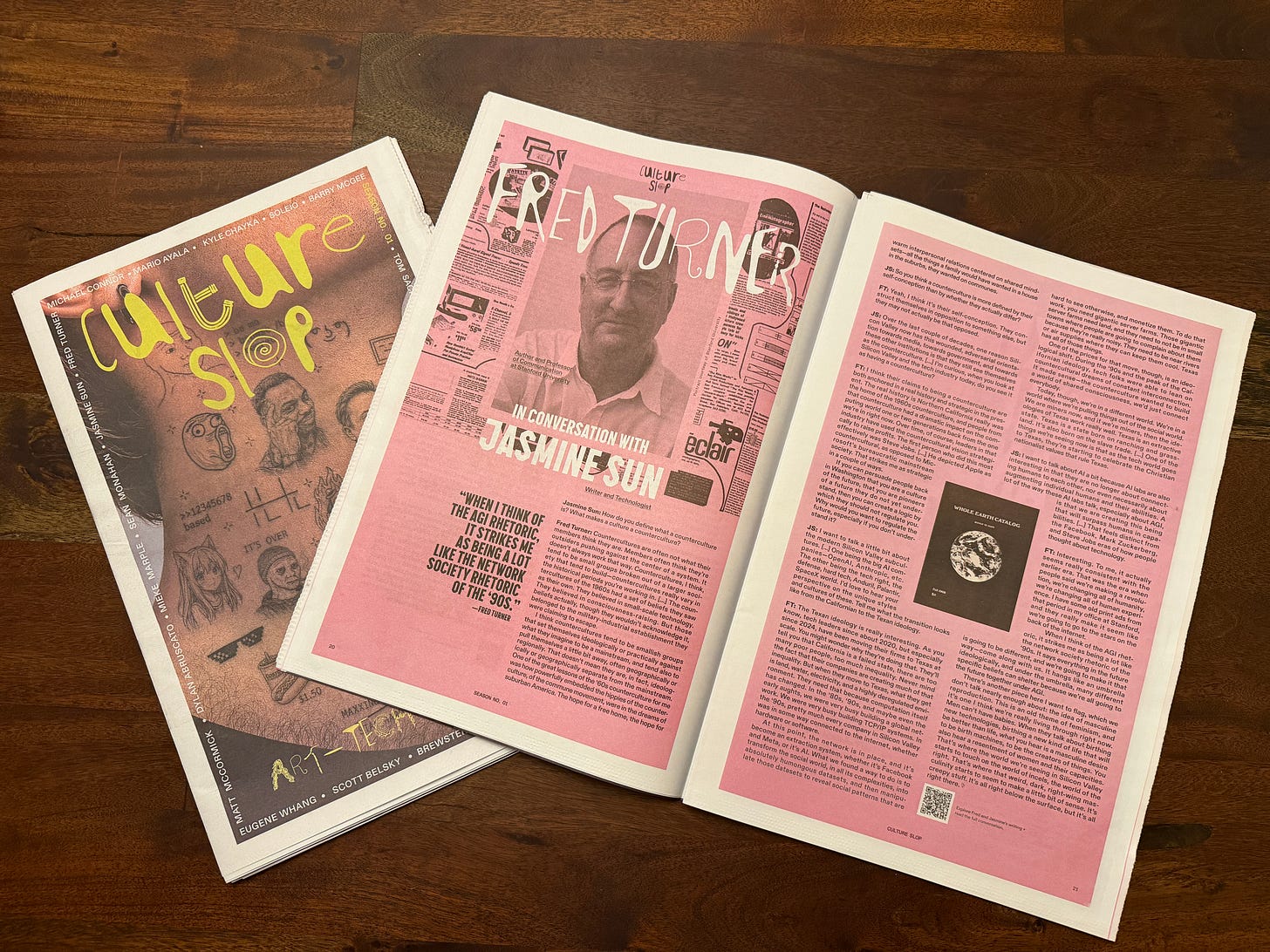
It’s time to birth the new world—
Jasmine
Except relationships! Play long games with people, don’t burn trust for short-term gains, assume your reputation will follow you over the years.
This is so great - I love your writing, Jasmine.
I am 36, and graduated into bad-but-not-this-bad economic conditions. I'm struck by how much of your advice here applied then too (minus the AI). It's now just applicable to much more people.
The bad news: the old world is dying 😔😱😬
The good news: the old world is dying🥳🙌🍾