
🌻 claude code psychosis
are your problems software-shaped?

If you tell a friend they can now instantly create any app, they’ll probably say “Cool! Now I need to think of an idea.” Then they will forget about it, and never build a thing. The problem is not that your friend is horribly uncreative. It’s that most people’s problems are not software-shaped, and most won’t notice even when they are.
I began thinking about vibecoding and personal software last May when writing a piece for the WSJ. The barriers to building apps are falling to zero, yet the only people doing it seemed to already be in tech. My friend Lucas Gelfond analogized this conundrum to the art of parkour. To most citydwellers, stairwells are stairwells, and walls are walls. But hostile architecture is no deterrent to the traceur. They develop what’s called parkour vision: “walls become nothing more than ‘vertical floors’ for example, there to be run up or along; metal handrails seem to morph into intricate pathways to be walked; gaps in architecture become spaces to be filled with dynamic jumps.”
Perhaps “software vision” is a similar thing. Programmers are trained to see everything as a software-shaped problem: if you do a task three times, you should probably automate it with a script. Rename every IMG_*.jpg file from the last week to hawaii2025_*.jpg, they tell their terminal, while the rest of us painfully click and copy-paste. We are blind to the solutions we were never taught to see, asking for faster horses and never dreaming of cars.
Claude Code with Opus 4.5, Anthropic’s new coding agent, promises to make building software even easier. This December, my Twitter feed was blanketed with breathless proclamations and screenshots of apps made by non-engineers. Analysts called it a “ChatGPT moment” or the end of enterprise SaaS; some whispered—against the vibe—it might even be AGI.
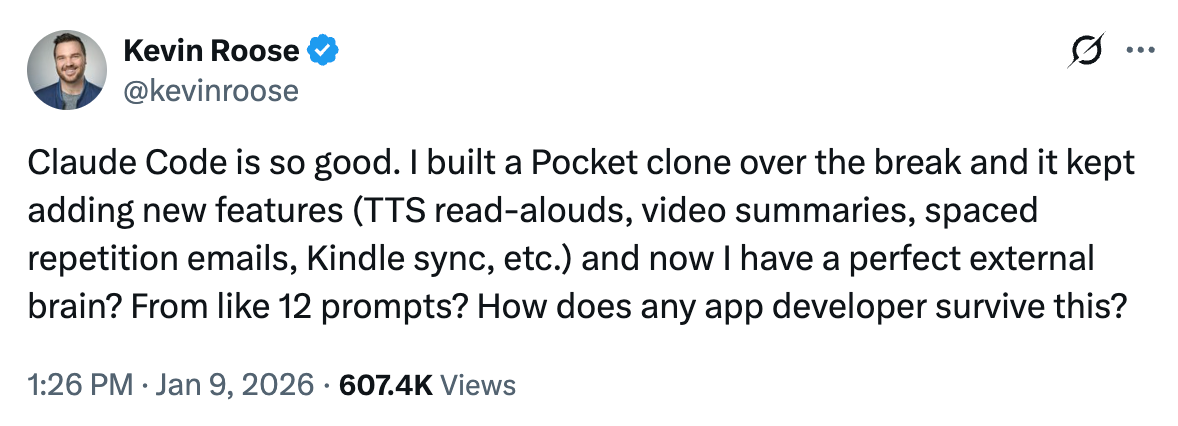
Well, I get it. I am embarrassingly nontechnical and scared of CSS, but spent every day last week talking to Claude Code more than my friends. It is an incredible technology that has made me more AGI-pilled than ever, while also being a net decrease on my productivity (and I’m not alone). This is my attempt to reckon with both.
the learning curve
I’d wanted to try Claude Code for a while, but simply didn’t know what I should build. I didn’t have parkour vision, err, software vision; I couldn’t think of a problem in my life that was software-shaped. People say that Claude Code can do anything with files on your computer, but almost all my work is on the web. People say it’s a superhuman plotter, but I primarily live in words. So I ignored the hype, had a lovely Christmas, and did not try Claude Code for months.
Eventually I came up with a first task: I needed to stitch together three PDFs for a grant application. The online discourse made Claude Code sound exceptionally easy—like it requires no technical skill, can one-shot complex apps, and never ships a bug. But for the truly uninitiated, I don’t think this is true.
Here’s what using Claude Code initially felt like: cooking with ingredients from a stranger’s fridge, the blankness of a page before you start writing, solo traveling in a country where you don’t speak the language. It’s hard to know what to build, hard to know how to start, and sometimes stuff doesn’t work the way you expect. As with all these analogues, you will eventually enter a flow state. But it took my fair share of false starts to get there, and I (the human) was very much in the loop.
To enumerate my early fumbles: I installed Claude Code, but couldn’t figure out how to start it. It seemed really dumb, then I realized it was stuck on the Haiku model. It took me 10 minutes to switch it to Opus 4.5, and another 10 to figure out how to undo what I typed (I’ve never used my terminal before). Then Claude kept pausing to ask for permission, but I had no clue what it meant. Eventually, I gave up on parsing these requests and started treating them like Terms & Conditions, mindlessly mashing 2: Yes and don’t ask again. Once I finished, I didn’t know the file location. And if I close a terminal window with a project, how would I tweak it again?
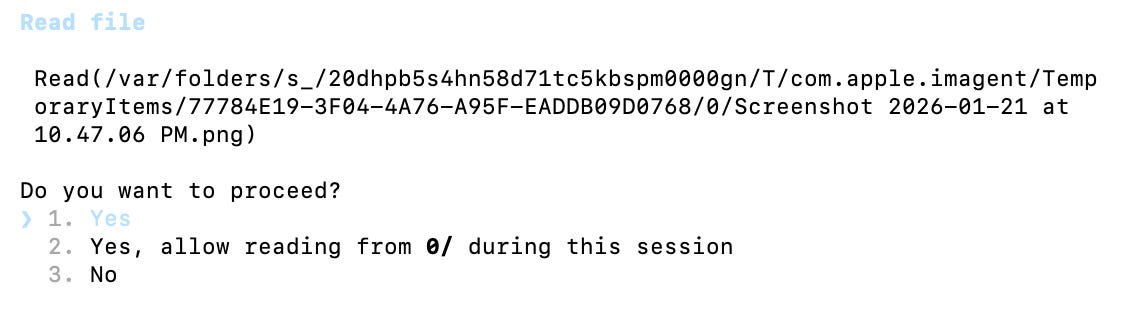
I’m sure the programmers are laughing at me, PEBCAK, whatever. I’ll take the ego hit to say that Claude Code was less intuitive than it seemed—more like learning to drive than the magic of teleportation. But half an hour later, my task was complete: Claude combined my PDFs and I submitted my application.
i don’t think claude is a crazy crazy step change from when i tried cursor a year ago, I sent to a group chat. I was still hiking up the learning curve.
claude code psychosis
A few days later, a friend sent me a voice memo instead of a text, and a collaborator asked me for feedback on a plan shared via YouTube. Unfortunately I am a psycho who refuses to listen instead of reading. So I had Gemini convert both files to text and sent off my replies.
Oh, I noticed. I do this over and over. Copying and pasting, uploading and downloading, turning audio and video into text for me to read. Maybe *this* problem is software-shaped.
I opened Claude Code in my terminal, and asked it to automate my flow. I explained what I did manually and crossed my fingers it’d work:
make me a tool where I give you a youtube video of a podcast, and then you 1. extract the transcript 2. go to aistudio.google.com and use Gemini pro 3 to clean up the transcript using the below prompt 3. save the cleaned up transcript (ideally as a google doc, but as a .md markdown file if you cant do that)
A few back-and-forths later, Claude made a web app that did everything I wanted. It converted YouTube URLs into clean, grammatical transcripts with chapters and takeaways; you could download it in Markdown or as a PDF. I added Tahoma, Comic Sans, and Wingdings to the PDF font selector. I reskinned the app to an aesthetic inspired by Microsoft Word 2003. I added a Windows XP toolbar and made the background “Bliss.” I was giddy with power and flexed it all I could.
The experience was pleasantly reminiscent of my time as a PM: I wrote user problems in plain English, and Claude translated them into software solutions. I approved plans, tested prototypes, and sent screenshots of bugs. When I got strange errors, I’d paste them in our chat. We discussed time-complexity tradeoffs, and it picked the tech stack. Sometimes Claude dished commands right back—grab the Gemini API key, connect Vercel here—but I was happy to comply. The collaboration felt genuinely two-sided.
I found myself subconsciously benchmarking Claude against the human engineers I’ve worked with. It’s better than the anxious juniors who needed specs for every edge case, but not as good as the senior engineers with both clean code and product sense. Like people, Claude tends toward hubris—I learned to always test things myself before accepting “It’s done!” Yet unlike humans, it is preternaturally patient, whirring away tokens to fulfill every superfluous request.
Once my YouTube converter was complete, I put the project up on Github, Twitter, Substack, and told all my friends. Even getting my first bug report felt like an honor. Is this what it feels like to be a cracked coder? I text a friend after fixing it. I get why the hackathon kids are obsessed with side projects now.
I dubbed this phase my “Claude Code psychosis,” though some argue “mania” is the better term. It’s addictive to express a vision and see it instantly appear, getting into the build/test/iterate loop at an electrifying rate. There’s an apt joke that Claude Code is GPT-4o for nerds: it reflects your desires and makes them real, providing the rush of creation with minimal sweat.
high-agency AI
I now get why software engineers were AGI-pilled first—using Claude Code has fundamentally rewired my understanding of what AI can do. I knew in theory about coding agents but wasn’t impressed until I built something. It’s the kind of thing you don’t get until you try.
When talking to a standard chatbot, it still feels plausible that AI is “fancy autocomplete” or a “bullshit machine.” They write cutesy poems or dole life advice; they can answer trivia confidently and don’t always know when they’re wrong. I’m a daily active user of ChatGPT, but it feels more like an adviser than something replacing my work.
Claude Code, meanwhile, is clearly autonomous. It can do and not just say. It’s impossible to watch it make an app and maintain the facade of AI as “next-token prediction.” With a one-sentence prompt—create a YouTube transcription app that looks like Windows XP—it will find design inspiration, write code, and open-source it on Github. This is not mere memory and regurgitation. This is something that can accomplish a novel multipart task.
The performance of coding agents is measured in degrees of agency: How long can the AI work without human help? Can it break down a vague, complex mandate into bite-sized steps? Can I leave Claude alone and let it cook? More and more, the answer is yes. Chat is still the interface but no longer the product. Arguably, Claude Code is a high-agency AI.
Seeing AI work autonomously is both thrilling and scary. Using Claude Code struck a visceral chord in how I view the importance of alignment. It’s one thing to theoretically debate whether people will transfer power to AIs; it’s another to hand my full computer permissions to this thing that I don’t understand. We know intellectually that bugs or insecurities could wreak havoc with our files, but never mind stated preferences: people pick speed over security all the time.1
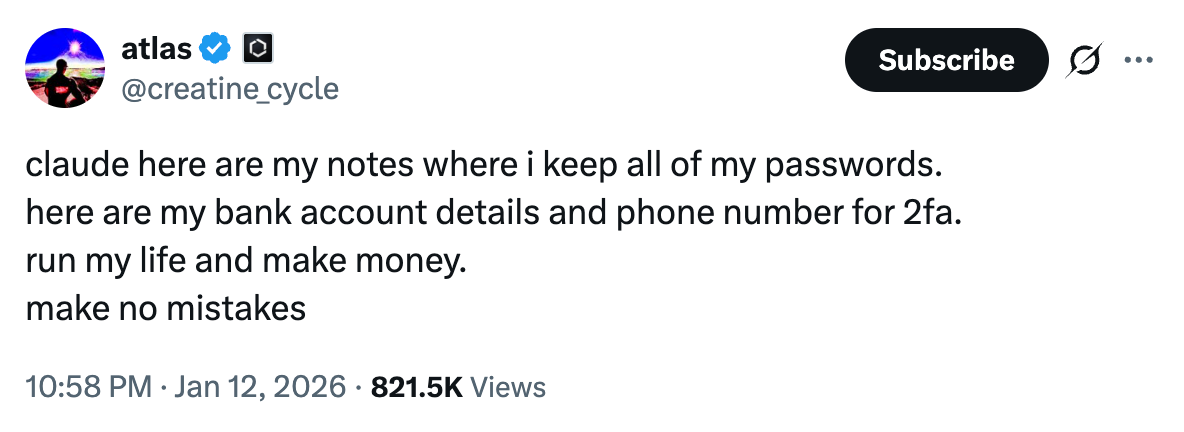
Let’s now scale up AI agency to the corporate context. In my brief stint as a growth PM, I was tasked with increasing installs of the Substack app. This meant querying a list of the most-visited platform pages and A/B testing app upsells on the top ones (stay signed in with the Substack app, read the login page banner). This was important but it was also mind-numbing. From PM to designer to engineer to data analyst, we all dragged our feet until it took months to complete.2
Recently, a friend asked if I thought Claude could’ve PMed for me—whether, given the mandate to “Increase app downloads,” it could pull data, draft copy, and run these experiments itself. Not yet, I replied. But probably in a year.
There are paperclips everywhere for those with the eyes to see them. AI today is the worst that it’ll ever be.
software abundance
The first-order effect of Claude Code is software abundance.
It will soon cost near-nothing to have whatever app you want. Vibecoding is already shifting the build vs. buy calculus: maybe we’ll all spend less money on SaaS (and more on Claude credits instead). And because it’s economical to build custom tools for narrow personal, small business, and community use cases, exiting enshittification is easier than ever before.
Moreover, if you’re sick of the corporate web or miss aesthetic variety, the home-cooked app renaissance is as good as it gets. I made sites to track meals, my iMessage stats, and every time a nation declared a “Sputnik moment.” Goodbye to the airspace era of software design—I’m delighted to have more opinionated software, where scalemaxxed sterility is replaced with bespoke builds and pizzazz. And as with the digital democratization of publishing, photography, and more, I believe creativity will emerge from everywhere. The number of fun websites, games, and apps will explode.
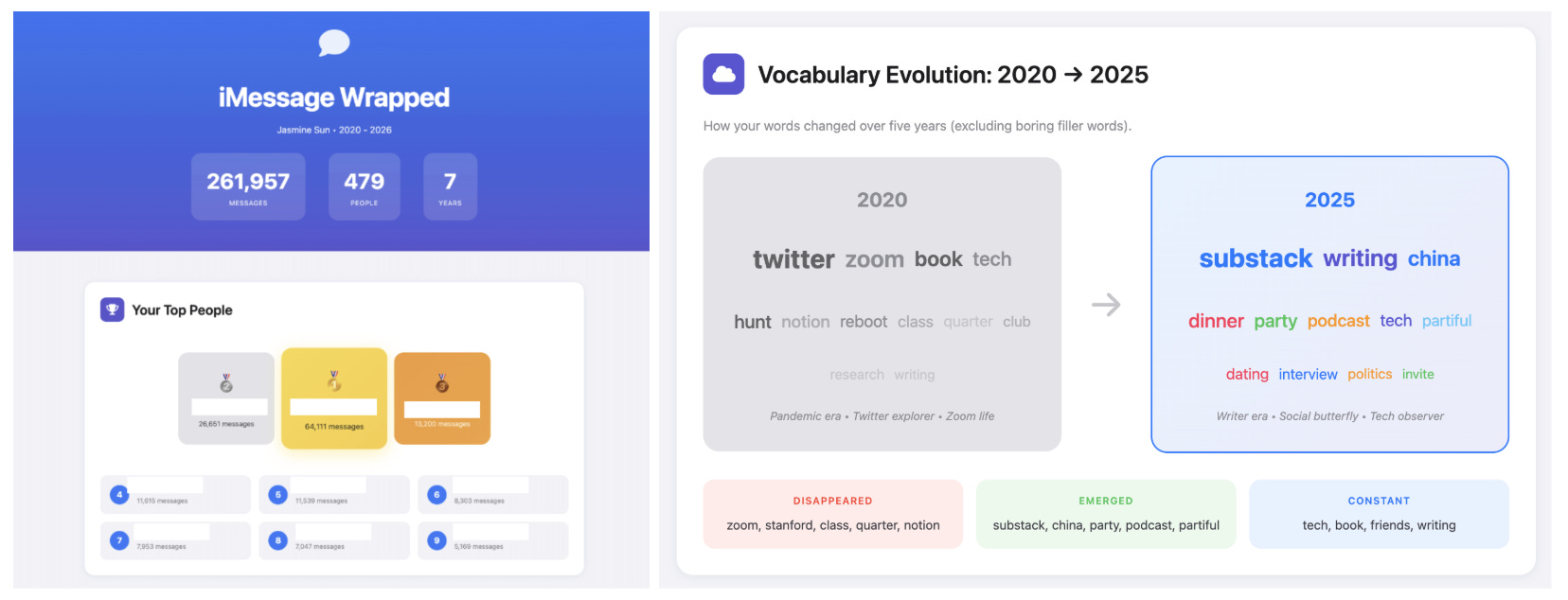
The second-order effect of Claude Code was realizing how many of my problems are not software-shaped. Having these new tools did not make me more productive; on the contrary, Claudecrastination probably delayed this post by a week.3
I had Claude resurface texts I forgot to respond to, and realized that the real blocker—obviously—was that I didn’t want to reply. I’ve tried countless apps to shut out distractions, but procrastinate just as well by staring blankly at walls. What’s actually tough about my job is coming up with novel frames for important ideas and devising sentences that are equal parts sharp, lively, and true. You can have the best Deep Research reports in the world, and still lack a unique point of view.
I’m not the only one having this issue. Just because Claude Code can be wielded by a nontechnical person does not mean it’ll be a big productivity boon. Sentence generation is a software problem, but insight is not. Sending reminders is a software problem, but motivation is not. When you have a hammer, everything looks like a nail; when you can conjure solutions at will, you won’t stop to ponder why you built them.
Recall the viral METR study on AI-assisted coding, where engineers estimated a big boost but got much slower instead—I wonder if AI made coding easier but worse. I used the AI meeting notes app Granola until I realized I never read a single one of its recaps. Doing things the slow way forces you to make smart 80/20 tradeoffs. Whether atoms or bits, most of our problems are deeper than needing more stuff.4
Nevertheless, my Terminal icon is jumping up and down on my taskbar. I tab over to quiet it and say hello. It’s nice to have an assistant scurrying around to help me. It’s nice to be assigning it rote tasks instead of doing them myself. Claude Code is a straight-A student, an eager intern, ever-ready for my command. I marveled at the hard box of my computer, now malleable in my hands.
Claude Code genuinely is a ton of fun, and I strongly recommend you spend some time building something—just because it will change your perception of what AI (and you) can do, and maybe you’ll actually have software-shaped problems to solve! Below, I share:
My Claude Code guide for absolute dummies
Favorite recent reads on Bay Area culture
Hand-picked career opportunities
Personal updates + DC meetup
I’m experimenting with an occasional paywall as I pause other work to make Substack my focus. I want to keep essays free, but may offer things like guides/links/extras for paying subscribers. I appreciate the support <3